16th century
Shipbuilding begins
Ships were already being built along this coast in the 16th century. Over the following centuries, the area became one of Finland’s major shipbuilding regions.
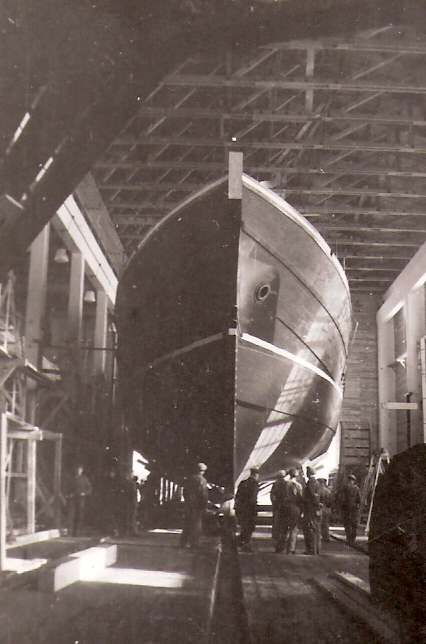
Jakobstad was founded in 1652 beside one of Ostrobothnia’s finest harbours, and the town has relied on shipping, trade and shipbuilding ever since. More than a thousand sailing ships were built in the area over the centuries. Tar, pitch and ships were sold around the world, laying the foundations for the town’s prosperity.
Post-glacial land uplift made the water shallower, and the harbour had to move farther out. By the mid-19th century, Old Harbour was no longer used as the town’s harbour.
After the Second World War, Finland built 91 wooden schooners as war reparations to the Soviet Union. Vega was one of them. In the 1980s and 1990s, the tradition was revived in Old Harbour. Jacobstads Wapen was rebuilt and Vega was brought home from Tallinn. Today, the heritage lives on at Skeppsgården and at the shipyards in the region that build sailing yachts.
16th century
Ships were already being built along this coast in the 16th century. Over the following centuries, the area became one of Finland’s major shipbuilding regions.
1652
Ebba Brahe ordered a town to be established by the harbour of Pedersöre, the harbour we now call Old Harbour. The harbour determined where Jakobstad would be located.
1666
The Momma brothers probably operated a shipyard by the harbour until 1672.
1753
A pitch works was established at Old Harbour. Pitch was needed to caulk ships, and in the 18th century around 1,500 barrels were produced each year.
1765
Towns in Ostrobothnia were granted the right to trade directly with foreign countries. Jakobstad received its staple port rights two years later, in 1767.
1767
The galleass designed by Fredrik Henrik af Chapman became the first ship from Jakobstad to sail abroad. Her maiden voyage was to Amsterdam.
Read more1797
Ten merchants established a joint shipyard. More than 150 sailing ships were built there by 1874.
1800
A straight road was cleared through the forest on Kittholmen to make ropes for ships. It still exists today as Banavägen.
The 1850s
Land uplift made the harbour bay too shallow. The town’s harbour moved to Alholmen, and the old harbour became known as Old Harbour.
1944
The armistice with the Soviet Union required Finland to pay war reparations in goods worth 300 million dollars, at 1938 prices.
1945
Oy Laivateollisuus Ab was founded in Turku to build wooden schooners. Designer Jarl Lindblom used laminated timber and serial production.
1952
Vega was schooner number 44 built at the shipyard in Turku and was delivered in July, the final year of the war reparations.
Read more1953
Vega trained cadets for the Soviet merchant fleet. By 1978, 3,116 cadets had gained their first experience at sea aboard her.
1986
Vega was hauled ashore at the Maritime Museum in Tallinn. There was not enough money for restoration, and she began to deteriorate.
1988
Construction of a replica of Jacobstads Wapen began in Old Harbour, based on Chapman’s drawings and carried out by volunteers.
1992
Jacobstads Wapen was launched on 12 July 1992 in front of a large crowd. Her maiden voyage took place in 1994.
Read more1996
The foundation was established to save Vega. The agreement was signed in Tallinn on 7 December, and Vega became the foundation’s property.
1997
Vega was towed on a barge from Tallinn and arrived in Jakobstad at six o’clock in the morning on 23 June.
Read more1999
Volunteers extended and clad the old hall. When the roof was completed in January 1999, Vega was protected.
2007
All the rotten frames in the bow had been replaced with new ones, made in the workshop next to the hall.
2011
The idea emerged to display Vega in three stages: her construction, deterioration and condition as in 1952.
Today
The captain’s cabin and wheelhouse on Vega have been rebuilt. Jacobstads Wapen is moored at the quay and is due to be rigged in summer 2027. The work continues.
Read moreThe longer texts about Vega and the war reparations are collected here.